It’s About Your Health, Safety
and
Comfort
 Carbon monoxide, even
in small quantities, can cause
serious health problems, Carbon monoxide, even
in small quantities, can cause
serious health problems,
particularly in children and the elderly.
Millions of unsuspecting
homeowners are exposed to low levels of CO and
don’t even know it.
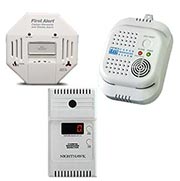
Unfortunately, U.L. Listed CO
alarms, like the ones pictured at left, don’t
go off until your family has been exposed to 70
ppm (parts per million) for over 3-1/2
hours!
Most international limits for
unsafe levels, including OSHA and the World
Health Organization’s guidelines are
between 15-35 ppm. 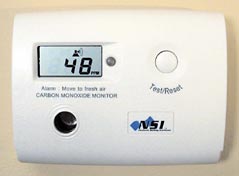
Click
here to see our special Carbon Monoxide
monitor. The NSI
low level monitor senses Carbon Monoxide
levels as low as 5 ppm
(parts per million).
It's not just your furnace
Carbon monoxide can come from
additional sources in your home besides your
heating equipment, and they should all be
checked.
These sources include your Water
Heater, Gas Range, Gas Logs, Space Heater,
Boiler – even an attached garage where you
warm up your car or start gasoline powered
lawn equipment can pass Carbon Monoxide into
the home.
Even New Equipment Needs to
Be Tested
Anytime equipment is installed,
it is being exposed to real conditions in
which it has never been tested to perform.
Equipment is tested in a laboratory under
tight standards that do not reflect the real
world of your home. Venting systems,
combustion air, duct systems, additional
appliances in the building, building pressure
etc., can all affect its operation. Besides
that, after leaving the factory it’s likely
your equipment has been loaded and unloaded on
trucks and transported several times.
Vibration and shock can cause components to
shift and move and adjustments to be knocked
out of calibration. The only way to truly know
if your new equipment is operating safely and
efficiently is to test it once it’s been
installed under real world conditions.
We Don't Just Guess - We
Measure 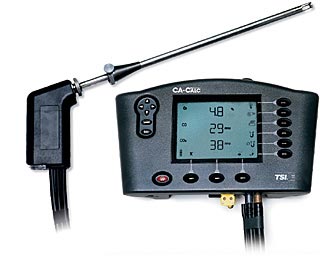
When we walk into your house
we’ll be carrying a Carbon Monoxide Monitor to
immediately check if unsafe CO levels are
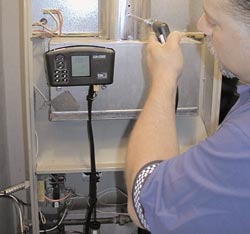
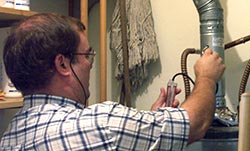
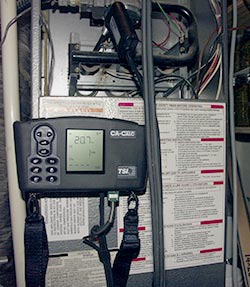
present. When working on the equipment, we
will insert the probe of an electronic
combustion analyzer inside to check actual
burner performance. We will be testing for
abnormal combustion, which can cause elevated
Carbon Monoxide levels and inefficiency
(wasted money).
Once we are finished testing we
will provide documentation and review our
results with you. In most cases, we can
remediate the condition, or refer you to our
preferred contractor for any needed repairs.
Frequently Asked Questions
About Carbon Monoxide Testing
QUESTION:
I have a CO Alarm in my house, shouldn’t this
warn me if there is a problem?
ANSWER: If you
purchased your alarm from a store, it will
usually only warn you of a life threatening
condition. If you read the fine print on the
product’s UL listing, you’ll find it offers
little protection for children, the elderly,
or persons with existing illnesses or CO
sensitivity.
QUESTION:
What level of carbon monoxide can be harmful?
ANSWER:
According to the World Health Organization,
15-20 ppm is the first level of CO that can
affect us. Levels as low as 30 ppm have been
discovered to cause heart problems. Store CO
alarms do not have to activate until they see
70 ppm for 3-1/2 hours!
QUESTION:
What type of alarm should I have then?
ANSWER: Ask us
for a low-level monitor that alerts you at
levels beginning at 15 ppm. Make sure it’s
battery operated and visually tells you it’s
working 24/7. Click
here to learn more about the low-level
monitor.
QUESTION:
Can’t I just call my gas company or appliance
repairman if I think I have a problem?
ANSWER: Would
you call the gas station if you had a problem
with your car? Gas companies are well versed
in fuel leaks, but their main business is not
appliance service. Few appliance repairmen are
Certified CO/Combustion Analysts.
QUESTION:
How do I know that Tradewinds Appropriate
Technologies have Certified CO/Combustion
Analysts?
ANSWER: You can
ask to see our NCI*
certification and we will gladly show you our
state-of-the-art electronic test equipment and
demonstrate how it measures the combustion and
carbon monoxide levels of your equipment.
|